
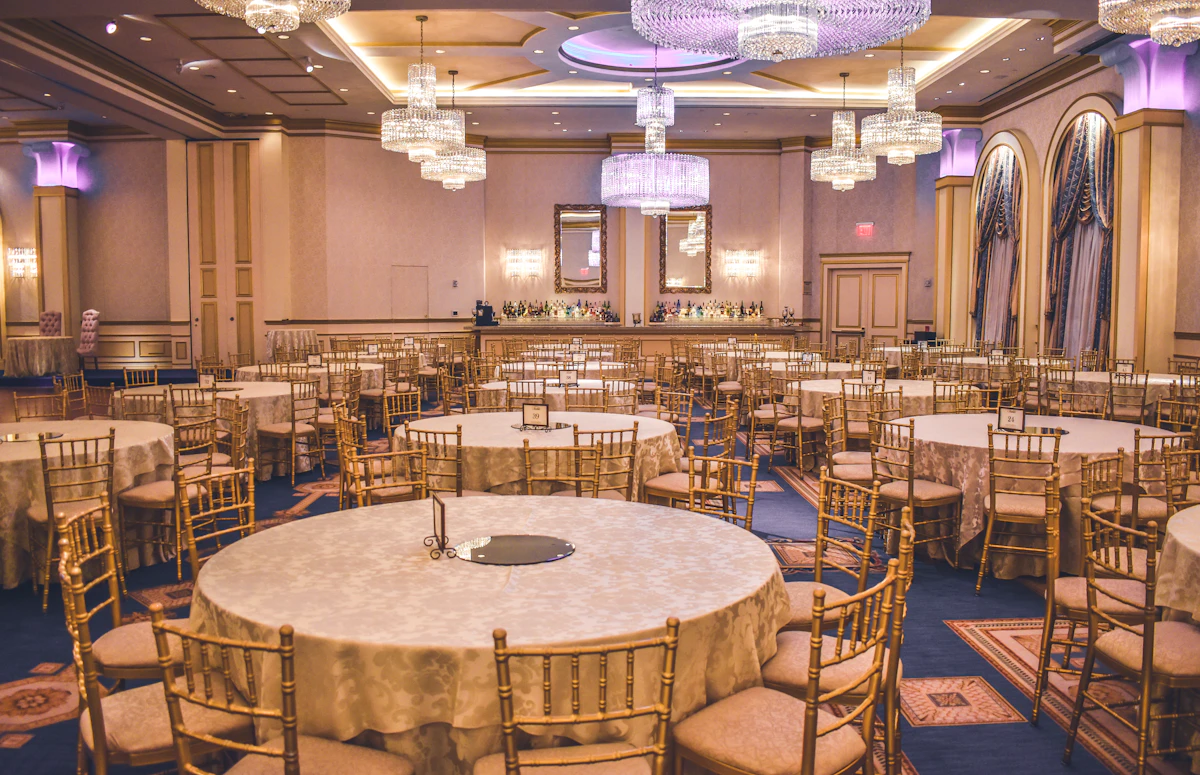
1. Executive Summary: The High-Stakes Reality of Banquet and Event Management
In the Indian hospitality ecosystem, banquet halls, marriage lawns, and hotel convention venues represent one of the highest-margin, highest-revenue business segments. Unlike standard hotel room stays where transactions typically range from ?2,500 to ?8,000 per night, a single wedding reception, corporate conference, or multi-day convention commands contract values between ?1,50,000 and ?25,00,000 or more.
However, high financial rewards come with immense operational complexity. A single banquet event requires the seamless synchronization of five critical business functions:
- Space Allocation: Reserving specific hall slots (morning, evening, or full-day) across multiple venues such as the Grand Ballroom, Terrace Lawn, and Boardroom without overlap.
- Catering & Menu Engineering: Managing per-plate (per-pax) pricing, custom multi-course live counters, high tea menus, and strict dietary preferences.
- Operational Execution: Creating and circulating precise Banquet Event Orders (BEOs) to kitchen chefs, decorators, audio-visual (AV) technicians, and service captains.
- Milestone Financials: Collecting token booking advances, staged pre-event deposits, and post-event incidentals while reconciling unexpected extra pax counts.
- Unified Room Reservations: For destination weddings and multi-day conferences, coordinating room blocks for out-of-town guests alongside the banquet hall reservation.
Despite these high stakes, a surprising number of banquet managers and venue operators across India still rely on manual paper diary logs, fragmented WhatsApp chats, and basic spreadsheet calculators. On auspicious wedding dates (known as Saya or Shubh Muhurat dates), when venue demand peaks dramatically, manual record-keeping inevitably leads to operational catastrophe: double-booked event halls, miscommunicated menu items, untracked payment advances, and hostile client disputes.
Deploying a modern, cloud-based banquet management system is the definitive solution to eliminate booking collisions, automate BEO workflows, secure milestone payments, and deliver flawless hospitality events.
Digital Banquet Automation vs Legacy Diary Registers
Legacy Physical Diaries & Excel
- • Double-Booking Disaster Risk: High vulnerability during peak Saya dates when multiple sales managers take inquiries
- • Kitchen Menu Miscommunication: Handwritten notes lead to missing food counters and customer disputes
- • Untracked Advance Balances: Up to ₹2,00,000+ in overdue client payments delayed past the event date
- • Disconnected Room Blocks: Guest room folios managed separately from hall catering, causing checkout friction
Modern Cloud Banquet Engine (BillDhari)
- • Visual Time-Slot Calendar: Instant color-coded visibility into Tentative, Confirmed, and Blocked event slots
- • 1-Click Digital BEOs: Automated Banquet Event Orders generated and shared directly to chef tablets and banquet staff
- • Automated Milestone Billing: Automated WhatsApp payment links for token, 50% pre-event, and final settlements
- • Unified PMS Master Folio: Consolidate wedding banquet catering, decorator charges, and 30 hotel rooms on one GST invoice
2. Why Generic Billing and Accounting Software Fails for Banquet Halls
Many venue owners initially try using general retail billing tools or standard accounting software like Tally or basic POS apps. While these tools handle simple product sales, they completely break down under the operational demands of event spaces:
A. The Multi-Slot Time Collision Challenge
A banquet venue does not sell items off a shelf; it sells blocks of time. A single hall can host:
- A corporate training seminar from 09:00 AM to 02:00 PM (Morning Slot).
- A 3-hour turnaround window for deep cleaning and decoration reset from 02:00 PM to 05:00 PM.
- A high-profile wedding reception from 06:00 PM to 12:00 midnight (Evening Slot).
Generic retail billing software has no concept of venue turnaround buffers or time slots. It records a booking on a single date, leaving the afternoon and evening open to accidental double-booking by another sales coordinator. Dedicated banquet hall software with booking management locks specific hour windows and alerts staff to turnaround constraints automatically.
B. The Banquet Event Order (BEO) Disconnect
In hospitality operations, the Banquet Event Order (BEO) is the operational contract that drives the entire event. A comprehensive BEO includes:
- Exact arrival timing and welcome drink service protocols.
- Detailed food menu categorization (Soups, Starters, Live Chaat Counters, Main Course, Breads, Desserts).
- Hall setup format (Theater style, Cluster seating, U-Shape, or Floating buffet).
- Audio-visual requirements (Cordless mics, projector screens, LED backdrop walls).
- Third-party vendor permits (DJ sound license, external florist access timings).
When sales teams negotiate menu custom adjustments on paper, those changes rarely reach the kitchen executive chef accurately. A dedicated banquet system auto-generates digital BEOs directly from the agreed customer contract, ensuring the kitchen prepares the exact agreed menu without omissions.
C. The Guaranteed Pax vs Actual Pax Variance
In event catering, clients book based on a Guaranteed Minimum Pax (e.g. 400 guests). However, actual guest turnout frequently exceeds the guarantee (e.g. 465 guests arrive). Traditional billing tools force cashiers to calculate manual rate differentials on paper invoices. A dedicated banquet billing software automatically calculates: $$\text{Total Food Revenue} = (\text{Guaranteed Pax} \times \text{Agreed Rate}) + (\text{Extra Pax} \times \text{Agreed Rate})$$ This calculation is updated in real time during the event, enabling the venue manager to present a transparent, verified supplemental bill before the client leaves the premises.
3. Core Architectural Modules of Modern Banquet Management Software
A professional banquet management platform should integrate the following operational pillars into a unified interface:
Visual Slot Calendar
Interactive drag-and-drop calendar displaying morning, evening, and full-day bookings across all halls, lawns, and conference rooms.
Dynamic Menu Engineering
Build custom multi-tier packages (Silver, Gold, Platinum) with itemized live counter addons, per-pax pricing, and recipe costing.
Digital BEO Generator
Instantly export standardized Banquet Event Orders with kitchen, decoration, and AV setup instructions in 1 click.
Milestone Payment Engine
Track token advance, 50% pre-event deposit, and final settlement with automated WhatsApp balance payment reminders.
Unified Hotel PMS Integration
Seamlessly link banquet hall catering with guest room blocks, posting all charges to a single consolidated corporate or wedding folio.
Indian GST Billing Engine
Automate accurate SAC code classification (SAC 9963) with compliant 18% or 5% GST calculations and B2B invoice generation.
4. Indian GST Compliance Guide for Banquet Halls and Event Caterers
Tax compliance for event spaces and banquet venues in India requires strict adherence to Central Board of Indirect Taxes and Customs (CBIC) guidelines. Incorrect tax configuration creates heavy audit liabilities during annual assessments:
1. Applicable GST Rates for Banquet Services
- Outdoor Catering & Standalone Banquet Services: Standard banquet catering, bundled hall rentals, and event dining provided by standalone venues are taxed at 18% GST (9% CGST + 9% SGST) with full Input Tax Credit (ITC) eligibility on venue inputs, raw materials, and equipment rentals.
- Hotel-Attached Banquets (Declared Room Tariff Below ?7,500): If a hotel has room tariffs below ?7,500 per day, banquet catering services provided within the hotel premises are taxed at 5% GST without Input Tax Credit, or 18% with ITC depending on whether the service is classified as composite outdoor event catering.
- Hotel-Attached Banquets (Declared Room Tariff of ?7,500 and Above): Banquet operations in luxury properties and star-category hotels attract 18% GST with full Input Tax Credit.
2. Mandatory SAC Codes for Invoicing
A professional banquet billing software with GST invoice generation automatically classifies line items under the correct Service Accounting Code (SAC):
- SAC 996331: Services provided by banquet halls, convention centers, and wedding grounds with catering.
- SAC 996337: Outdoor catering services for social functions and corporate events.
- SAC 998599: Audio-visual equipment rentals, stage lighting, and event coordination add-ons.
BillDhari's integrated GST invoicing engine handles multi-tier rate splits automatically. When a wedding booking includes ?5,00,000 for per-plate catering, ?1,00,000 for floral decoration, and ?80,000 for 10 hotel guest rooms, the software itemizes each line item under its compliant SAC code and produces an unassailable tax invoice in seconds.
5. Milestone Payment Architecture: Protecting Venue Cash Flow
One of the largest sources of bad debt in the banquet industry is the failure to collect event balances prior to event execution. Once an event concludes and guests depart at midnight, collecting unpaid incidentals or extra plate charges becomes notoriously difficult.
A robust banquet software with advance payment tracking enforces a 4-tier milestone collection workflow:
Stage 1: Token Booking Advance (15% to 25%)
Collected at the time of date locking to convert an inquiry into a confirmed booking. The software generates an instant digital receipt and blocks the date across all sales terminals.
Stage 2: Menu Finalization Advance (40% to 50%)
Collected 15 to 30 days prior to the event when the client signs off on the final food menu, guaranteed pax count, and BEO setup specifications. Funds raw material procurement for the kitchen.
Stage 3: Pre-Event Final Clearance (Up to 90% or 100%)
Collected 48 to 72 hours before the event commencement. The client clears the baseline guaranteed catering cost, hall rentals, and equipment setups before the venue doors open.
Stage 4: Post-Event Settlement (Incidentals & Extra Pax)
Reconciled immediately at event conclusion. Extra guest plates, extended hall lighting hours, and supplemental beverage counters are billed against the pre-authorized security deposit.
6. How to Manage Banquet Hall Bookings Digitally: 5 Practical Steps
For venue operators transitioning from paper ledgers to cloud software, following a disciplined onboarding procedure ensures zero disruption to ongoing bookings:
Step 1: Map Physical Spaces and Turnaround Times
Enter every bookable area into your venue master - Grand Ballroom (Capacity: 600 Pax), Poolside Lawn (Capacity: 350 Pax), and Conference Hall (Capacity: 80 Pax). Set mandatory buffer windows (e.g. 3 hours) between consecutive events to allow adequate cleaning and stage decoration turnover.
Step 2: Digitize Menu Catalogs and Per-Plate Packages
Configure standard per-pax catering packages - Vegetarian Silver (?850/plate), Vegetarian Gold (?1,250/plate), Non-Vegetarian Premium (?1,650/plate). Include individual addon line items such as Live Pasta Counters, Wood-Fired Pizza Stalls, Mocktail Bars, and Specialty Desserts.
Step 3: Migrate Existing Paper Reservations
Input all future confirmed and tentative event bookings into the digital calendar. Reconcile past advance deposits collected via cash, bank transfer, or UPI to establish accurate opening balance ledgers.
Step 4: Train Front Desk and Kitchen Teams on Digital BEOs
Equip the banquet sales manager, food production executive chef, and banquet captain with mobile or tablet access. Ensure that whenever an inquiry changes its status to confirmed, the BEO is generated digitally rather than through verbal instructions.
Step 5: Automate Client Communications on WhatsApp
Enable automated booking confirmation vouchers, event countdown reminders, and milestone payment links sent directly to the host's WhatsApp number. Transparent communication establishes professional trust and speeds up advance payment recovery.
7. Frequently Asked Questions (FAQ)
1. Can the software handle multiple banquet halls on the same property?
Yes. Professional banquet management systems support multi-venue mapping. You can manage separate event schedules, capacities, and simultaneous bookings for the Grand Ballroom, Terrace Lawn, Conference Room, and Poolside Deck from a single unified calendar screen.
2. How does the system prevent double-booking on peak wedding dates?
The visual slot calendar enforces strict conflict checking. When a sales coordinator attempts to book a hall for a time window that overlaps with an existing confirmed reservation or its mandatory cleaning turnaround buffer, the system blocks the action and displays an immediate conflict warning.
3. Can we track extra plates (pax) during the live event?
Yes. Managers can input verified actual plate counts during or immediately after the event. The software calculates the difference between guaranteed pax and actual turnout, generating an instant supplemental bill for the extra guests at the pre-agreed contract rate.
4. How does banquet software integrate with hotel room bookings?
In integrated hospitality suites like BillDhari, the banquet module communicates directly with the hotel PMS calendar. When organizing destination weddings, managers can reserve 30 hotel rooms alongside the banquet lawn, consolidating room night tariffs, food catering, and incidental charges on a single master folio.
5. What GST rate applies to banquet bookings with food and hall setup?
In India, standalone banquet halls and outdoor event catering services are taxed at 18% GST (9% CGST + 9% SGST) with full Input Tax Credit under SAC code 996331. For hotel-attached banquet halls with room tariffs under ?7,500, specific composite supply rates may apply depending on property classification.
6. Can client quotes and payment receipts be sent via WhatsApp?
Yes. BillDhari generates branded PDF quotes, detailed Banquet Event Orders (BEOs), and payment receipts that can be dispatched directly to the customer's WhatsApp number with integrated UPI payment links.
8. Conclusion: Transform Venue Operations and Profitability with BillDhari
In the fast-moving event hospitality industry, reputation is built on precision. A single mismanaged event - an unrecorded menu change, a delayed stage setup, or an advance payment dispute - can inflict lasting damage on a venue's local market reputation.
By transitioning from manual diaries to a dedicated cloud-based banquet management system, venue operators gain total calendar control, eliminate double-booking vulnerabilities, automate kitchen BEO communication, and protect venue cash flow through disciplined milestone payment automation.
Ready to take your banquet venue to the next level? Explore the BillDhari Banquet and Event Management Suite to experience seamless multi-hall scheduling, automated per-plate billing, and 1-click BEO generation designed specifically for Indian banquet halls, wedding lawns, and hotel event spaces.